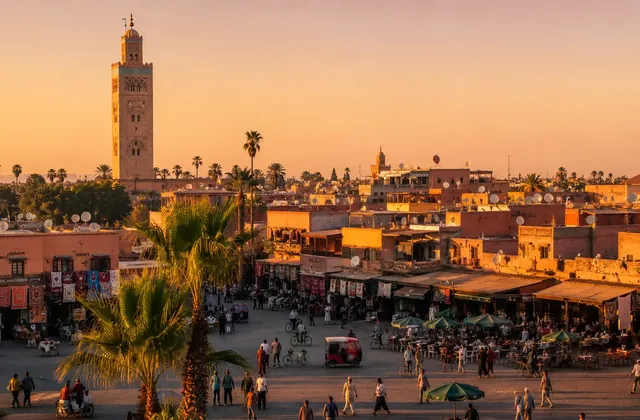
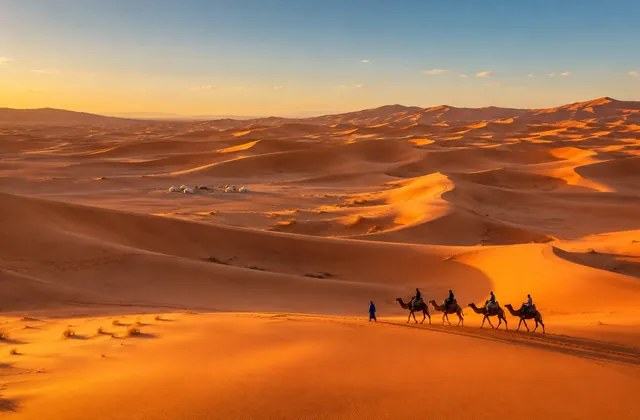
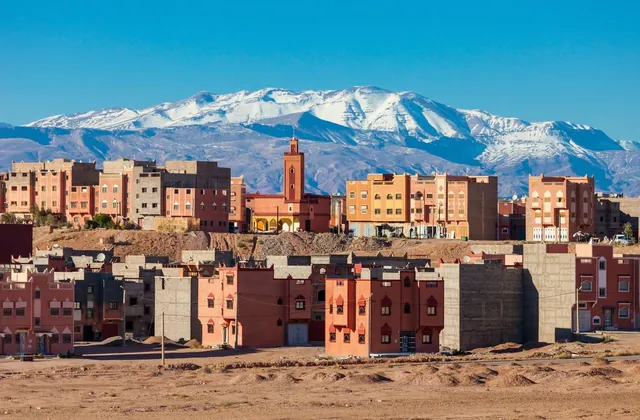
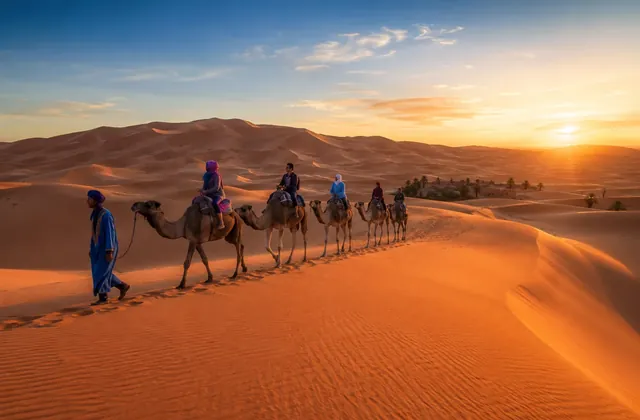
Renting a car in Morocco offers great freedom to explore the country, especially when an itinerary includes several cities, the Atlas Mountains valleys, villages, or southern Morocco. Many major roads are easy to navigate, but rental and driving conditions should be checked before setting off.
The price displayed at the time of booking is not enough to compare two offers. Deposit, excess, insurance, type of credit card accepted, mileage, fuel policy and condition of the vehicle can be more important than a few euros difference in the daily rate.
Do you need to rent a car to travel in Morocco?
It all depends on the itinerary. To visit only Marrakech , Fez , Rabat , Casablanca or Tangier , a car may be unnecessary and even cumbersome in the city centre.
On the other hand, it becomes particularly practical for linking several stages, travelling along the Atlantic coast, crossing the Atlas Mountains or discovering regions like Ouarzazate , the Dadès Valley, Tinghir , the Drâa Valley or Merzouga .
The car also allows you to stop freely in villages, at viewpoints and in sites located away from public transport.
Book in advance or rent on site?
Both options are possible. However, booking before the trip allows you to calmly compare the conditions and know in advance the vehicle category, the total price and the amount of the deposit.
During peak periods, booking in advance also allows you to have more choice, especially for automatic vehicles, SUVs or 4x4s.
Don't just compare the daily price. Also check the included insurance, mileage, any airport fees, the second driver, the fuel policy, and the cancellation conditions.
What documents are needed to rent a car?
The required documents depend on the rental company, but you will generally need to present:
- a valid driver's license;
- a passport or identity card;
- a bank card in the name of the main driver;
- the booking confirmation if the vehicle was booked in advance.
The age and driving license requirements vary depending on the rental agency and the vehicle category. Some rental companies, for example, impose a higher minimum age for SUVs, 4x4s, or high-end vehicles.
If your license is not written in the Latin alphabet, an international driving permit may also be required. Check this requirement with the rental company before you leave.
Credit card or debit card: beware of the deposit
This is one of the most important points to check before booking.
Many rental companies require a credit card in the name of the main driver to secure the security deposit. A debit card may be declined even if the account has sufficient funds.
The term "bank card" used during the booking process can therefore be misleading. Check carefully whether the agency accepts cards marked "debit" or if a genuine credit card is required.
The card must also have a sufficient spending limit to allow pre-authorization.
Caution and deductible: they are not the same thing
The security deposit is usually a sum of money temporarily held on the bank card at the time of vehicle collection. It is released after the vehicle is returned if no amount needs to be withheld.
The deductible corresponds to the amount that you may have to pay in the event of damage or theft, according to the insurance contract.
The two amounts may sometimes be close, but they do not refer to the same thing. Before confirming a reservation, clearly ask for the amount of the security deposit and the deductible.
What does the insurance actually cover?
Terms like CDW, Super CDW, excess waiver or full protection do not mean exactly the same thing with all rental companies.
Insurance can reduce your financial liability without necessarily covering all parts of the vehicle.
Depending on the contract, certain protections may exclude:
- the tires;
- the rims;
- the windows and the windshield;
- the underside of the vehicle;
- the interior;
- the keys;
- damages occurring on a road prohibited by the contract.
Before signing, read the exclusions and check the amount you will still be responsible for in case of damage.
Does your bank card already cover the rental?
Some premium bank cards offer guarantees for rental vehicles when payment is made with the card in question.
This coverage can help you avoid certain additional insurance policies, but you should read the terms and conditions carefully. Exclusions concerning 4x4 vehicles, off-road driving, certain vehicle categories, or specific vehicle parts are common.
Also check whether the insurance reimburses the costs after payment or covers them directly.
A vehicle inspection is essential before hitting the road.
Do not leave the agency without having checked the vehicle.
Every scratch, dent, bump, or other existing defect must be noted on the vehicle condition report. Also, take a few minutes to photograph or film the entire vehicle .
Pay particular attention to:
- the four sides of the bodywork;
- the bumpers;
- rims and tires;
- the windshield;
- the rearview mirrors;
- the roof if possible;
- the interior;
- the fuel level;
- the mileage.
If you notice any damage that does not appear on the document, ask the agency to add it before signing.
Also photograph the car on the return trip
The same precaution is useful when returning the item.
Before handing over the keys, take some photos showing the general condition of the vehicle, the fuel level and, if necessary, the mileage.
This can be particularly useful when the car is returned outside of opening hours and no employee immediately carries out the inspection with you.
Check the fuel policy
The simplest formula is usually full on departure and full on return .
In this case, check that the tank is actually full when you take the vehicle and fill it up before returning it.
Other plans may include a different fuel level or a prepaid tank. The important thing is to know the exact terms to avoid extra charges upon return.
Driving in Morocco: the main rules
In Morocco, they drive on the right and overtaking is done on the left.
The limitations that are generally applied are:
- 60 km/h in built-up areas;
- 100 km/h on national roads;
- 120 km/h on the motorway.
These values are general limits. A lower limit may be indicated locally, and it is always the road signs encountered on the road that must be obeyed.
Wearing a seatbelt is mandatory and using a handheld phone while driving is prohibited.
Speed cameras and traffic controls
Speed checks are frequent in Morocco, both at the entrance to cities and on major roads.
You'll encounter fixed speed cameras as well as mobile speed checks. It's therefore best to respect the posted speed limit, even on a road that appears clear.
Speed limit changes can also be rapid when approaching a built-up area, intersection, or inhabited area.
A road trip in Morocco is not a reason to try to save time on the fast sections: the distances can be significant and it is better to plan realistic stages.
Driving in Moroccan cities
Traffic can seem chaotic when you first arrive in a big city. Cars, taxis, scooters, bicycles and pedestrians sometimes share a relatively dense space.
In Marrakech , Casablanca or Fez in particular, it is best to adopt a calm driving style, anticipate more and not rely solely on the behaviors one is used to in Europe.
Avoid driving unnecessarily into congested areas with a rental car if possible. Accommodation with parking or close to road access can greatly simplify your stay.
Watch out for pedestrians, cyclists and animals
On some roads, particularly outside major cities, it is common to encounter pedestrians, bicycles, scooters, carts or animals close to the roadway.
Caution is particularly important at night, when some road users can be difficult to distinguish.
British authorities also recommend increased vigilance on Moroccan roads at night, particularly due to sometimes limited lighting and the presence of pedestrians and animals.
Should we avoid driving at night?
Driving at night on the motorway or around major cities does not necessarily pose any particular difficulty.
On secondary, mountainous or rural roads, however, it is often more comfortable to travel during the day.
Reduced visibility, turns, pedestrians, animals or poorly lit vehicles can make driving more tiring.
When planning a tour, therefore, allow sufficient time so that you do not have to systematically finish the stages after nightfall.
Do the roads in the Atlas Mountains require a 4x4 vehicle?
Not necessarily.
Many main roads crossing the Atlas Mountains are paved and can be traveled with a conventional car when conditions are normal.
The difficulties stem more from narrow roads, bends, changes in elevation, and weather conditions than from a systematic need for all-wheel drive.
In winter, snowfall can affect some mountain passes and, after heavy rain, secondary roads can temporarily become more difficult.
Before a stage in the mountains, find out about road conditions rather than assuming that a 4x4 automatically solves all problems.
Do you need a 4x4 to go to the desert?
To reach the main towns and villages in the south via paved roads, a 4x4 is generally not essential.
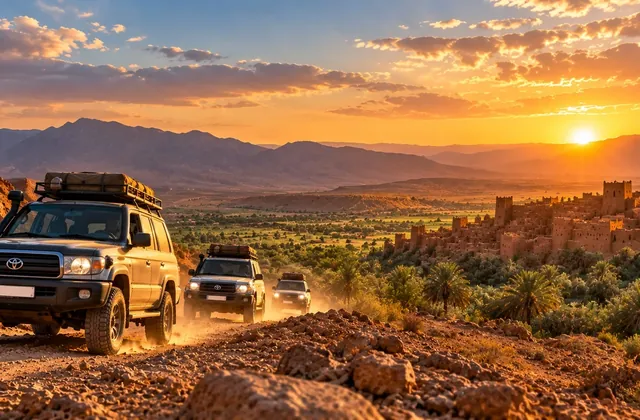
However, as soon as the route includes actual tracks, sand or unpaved sections , a suitable vehicle may become necessary.
However, two things must be distinguished: having a 4x4 and having the right to use it on a track.
Some rental agreements prohibit driving on unpaved roads or exclude damage incurred under such conditions from insurance coverage. Even with a 4x4, therefore, check that the planned route is permitted under your contract.
Don't confuse a 4x4 with authorization to go off-road.
Renting an SUV or 4x4 does not automatically give permission to drive everywhere.
Rental companies may prohibit certain tracks, roads considered unsuitable for vehicles, or areas presenting a risk to tires and the underside of the vehicle.
If your itinerary includes a track leading to a bivouac, an isolated village or a desert area, ask the rental company if this use is permitted.
In many cases, it is simpler to leave your car at the accommodation or meeting point and do the actual desert part with a driver or local guide.
Secondary roads: do not rely solely on the time indicated by the GPS
A relatively short distance can take much longer than expected when it crosses a mountain, a valley or several villages.
Navigation apps provide a useful estimate, but they don't always perfectly account for stops, roadworks, slowdowns, or winding sections.
On a road trip, it is therefore preferable to plan reasonable stages rather than covering long distances every day.
Highways and tolls
Morocco has a motorway network linking several major cities.
The highways are toll roads. Autoroutes du Maroc currently accepts cash, bank cards and the Jawaz pass at the tollbooths.
For occasional travel with a rental car, it is generally not necessary to have a Jawaz subscription, unless the vehicle is already equipped with one or you plan to do a lot of motorway driving.
The ADM Trafic app and website also allow users to check traffic conditions, roadworks, service areas and toll rates.
Fuel: petrol or diesel?
There are many petrol stations on the main roads and around the cities.
Before heading to a more isolated area, especially in the south or in the mountains, it is nevertheless preferable not to wait until the tank is almost empty to refuel.
Also check upon picking up the vehicle whether it runs on petrol or diesel. Using the wrong fuel can result in significant costs and is not necessarily covered by the rental company's assistance.
Parking in cities
In urban centers and tourist areas, parking can be more complicated than driving itself.
Public and private parking is available in many cities. Some accommodations also have their own parking or work with a nearby parking lot.
On some streets, someone may also be monitoring parked vehicles and asking for a small fee upon departure. If you are unsure about parking rates or regulations, ask your accommodation provider or choose a clearly marked parking area.
What to do in case of an accident?
In case of an accident, contact the rental company immediately and follow the procedure outlined in the contract.
An amicable settlement may be necessary when a third party is involved. Depending on the situation, the authorities may also need to intervene.
Don't rely on a verbal agreement with the other driver without knowing what your insurance policy requires. The absence of an accident report or statement can cause problems when dealing with your insurance company.
Also, keep the rental company's assistance number in your phone before leaving the agency.
What should I check before returning the car?
- Respect the fuel level specified in the contract.
- Remove all your personal belongings.
- Photograph the exterior condition of the vehicle.
- Photograph the fuel level and mileage if necessary.
- Request a return inventory check when possible.
- Keep the rental documents until the security deposit is released.
The bank pre-authorization is not always released immediately after the return. The delay may also depend on your bank.
The main mistakes to avoid
- Booking based solely on the daily price.
- Arriving with a debit card when the rental company requires a credit card.
- Do not check the amount of the deposit.
- Confusing a deposit and a deductible.
- Signing the vehicle condition report without inspecting the vehicle.
- Do not check the insurance exclusions.
- To embark on a course without knowing if the contract allows it.
- Planning excessively long stages on mountain roads.
- Returning the vehicle without proof of its condition when the agency is closed.
Classic car, SUV or 4x4: which to choose?
For a route consisting mainly of highways and paved roads, a standard car is sufficient in most cases.
An SUV can provide more comfort, ground clearance and luggage space, but is not essential.
The 4x4 becomes truly interesting when a route includes authorized tracks or areas where road conditions justify it.
Choosing a larger vehicle just "just in case" is not always an advantage: it generally costs more and can be less practical in medinas, small streets or narrow parking lots.
Rent a car or travel without a car?
Renting a car isn't essential for every trip. Morocco also has trains, buses, taxis, and transfers that allow you to travel many routes without driving.
The car becomes particularly interesting when freedom of route, intermediate stops and access to less-served regions are part of the journey.
Before booking, compare your itinerary with the options presented in our guide " Travelling in Morocco without a car: how to get around?" .
One last check before taking the keys
Before leaving the agency, make sure you understand the main conditions of the contract: deposit, deductible, insurance, fuel, mileage, authorized drivers and permitted roads.
Spending about ten minutes taking stock of the situation and reading the conditions can prevent a lot of discussion during the return.
Once these precautions are taken, the car remains one of the most pleasant ways to discover the Moroccan landscapes and to build an itinerary at your own pace.