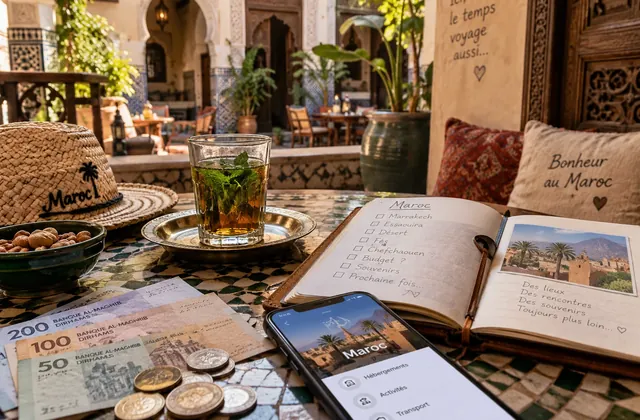
In Morocco, it's now easy to combine card payments and cash . Cards are commonly used in hotels, large stores, and many restaurants. However, cash remains essential for taxis, small shops, markets, some hostels, tips, and purchases in rural areas.
Therefore, it's generally not necessary to carry your entire travel budget in cash. The most practical approach is to have a bank card that can be used abroad, while always keeping some Moroccan dirhams on hand.
What currency is used in Morocco?
The official currency of Morocco is the Moroccan dirham , abbreviated DH or MAD.
The most common banknotes are 20, 50, 100 and 200 dirhams. Coins of 1, 2, 5 and 10 dirhams are particularly useful for small daily expenses.
In everyday life, prices are expressed in dirhams and it is in this currency that it is preferable to pay for purchases.
Can you pay in euros in Morocco?
In some very touristy areas, a shopkeeper, hotel, or service provider may accept euros. However, this does not mean that the euro is a commonly used currency in Morocco.
The merchant must then apply their own exchange rate, which is not necessarily as favorable as that of a bank or currency exchange office. Change may also be given in dirhams.
For daily expenses, it is therefore better to pay directly in dirhams rather than relying on the possibility of paying in euros.
Should you exchange your euros before leaving?
This is generally not necessary. It is easy to exchange currency once you arrive in Morocco.
Non-resident foreign visitors can keep the currency they brought and exchange it gradually as needed. Therefore, it is not necessary to convert their entire travel budget immediately.
This solution also helps to avoid ending up at the end of the stay with a significant amount of unused dirhams.
Where to exchange money in Morocco?
It is possible to exchange euros or other currencies in several types of establishments:
- currency exchange offices;
- the banks;
- currency exchange offices located in airports;
- some hotels.
In tourist towns, currency exchange offices are numerous and their rates are generally clearly displayed.
Before making a major transaction, look at the proposed rate and check if an additional commission is applied.
A passport may be required during the currency exchange transaction.
Should you exchange money at the airport?
Exchanging money at the airport is primarily a matter of convenience. It allows you to immediately have dirhams available to pay for a taxi, buy a drink, or make your initial purchases.
However, it's not necessary to convert your entire trip budget there. If you want to compare rates, you can exchange or withdraw a small amount upon arrival and then carry out the rest of your transactions in town.
The difference between two solutions depends on the rate offered, any exchange commissions and the fees applied by your own bank.
Can you withdraw dirhams from an ATM?
Yes. ATMs , often called GABs in Morocco, are very widespread in cities and major tourist destinations.
An international Visa or Mastercard card generally allows you to withdraw dirhams directly from your bank account.
This is a practical solution because it avoids having to carry a large amount of cash from one's country of origin.
In smaller towns or before heading into a valley, mountainous region, or desert area, it's best to withdraw enough cash beforehand. ATMs may be further apart, and some businesses don't accept cards.
What fees can be paid at the ATM?
A withdrawal made with a foreign card may incur several types of fees.
Your own bank may apply a fixed commission per withdrawal , a percentage on the amount withdrawn, or fees related to the conversion between the euro and the dirham.
The Moroccan bank or distributor may also apply its own terms and conditions. When an additional fee is charged by the distributor, this should normally be indicated before the transaction is validated.
Fees therefore depend heavily on your bank card. Before leaving, check the conditions applied to withdrawals made outside the Eurozone.
Is it better to withdraw several small amounts or one large sum?
If your bank charges a fixed fee for each withdrawal, making multiple small withdrawals can end up being more expensive.
Making slightly larger withdrawals can reduce the number of transactions. However, it's not necessary to carry a large sum of money with you all day.
A reasonable solution is to withdraw enough for several days and then keep only the money needed for daily expenses in your wallet.
Should I choose dirhams or euros at the ATM?
This is a particularly important point when using a foreign card.
Some ATMs may offer the option to withdraw cash in euros rather than dirhams . While the euro amount may seem easier to understand, this option uses a mechanism called dynamic currency conversion, or DCC.
In this case, it is no longer necessarily your bank that performs the conversion: the rate offered by the distributor or its service provider is directly applied to the transaction.
If you wish to let your own bank or card issuer carry out the conversion, choose the amount in Moroccan dirhams (MAD) and decline the proposed conversion to euros.
Paying by bank card in Morocco
Card payments are common in many hotels, restaurants, shops, supermarkets, petrol stations and tourist establishments.
Visa and Mastercard are widely used. However, the situation varies greatly depending on the type of establishment and the region.
In a large city or major hotel, paying by card is usually straightforward. In a small inn, a village grocery store, or a shop located in a medina, cash may remain the only available payment method.
Therefore, it is best never to rely exclusively on your bank card.
Should I choose euros or dirhams when paying by card?
The same question can appear on a payment terminal.
The terminal may offer you the option to pay directly in euros even though the price is initially displayed in dirhams. This is another example of dynamic currency conversion .
Paying in euros allows you to know immediately the amount that will appear in your account, but the conversion rate is then determined by the provider offering this service and may include a margin.
To let your bank do the conversion itself, generally choose MAD or dirhams when the terminal asks you which currency you want to pay in.
Should you always carry cash with you?
Yes. Even with a card that doesn't charge fees abroad, it's still useful to have banknotes and coins on hand.
Species are particularly useful for:
- the small taxis;
- the souks and markets;
- small grocery stores;
- cafes and small restaurants;
- some accommodations;
- purchases from small artisans;
- tips;
- spending in villages and rural areas.
It's also useful to keep small denominations on hand. Paying for a taxi ride or a small purchase with a 200 DH note isn't always practical.
How many types of cash should you carry with you?
There is obviously no one-size-fits-all amount for every traveler. In a city where you plan to pay for your hotel and main expenses by card, a few hundred dirhams is usually enough to cover taxis, drinks, light meals, and everyday purchases.
For example, keeping around 300 to 500 DH easily accessible can be practical for a typical day, with an additional reserve stored separately if necessary.
For an excursion, a trip to the Atlas Mountains, a stop in the desert or several days in a rural area, it is best to plan for more cash before leaving a major city.
However, it is not necessary to carry your entire travel budget with you at all times.
Small bills are particularly useful
The 20 and 50 DH banknotes and the 1, 2, 5 and 10 DH coins are very useful on a daily basis.
When you make a withdrawal or exchange money, try not to keep only 100 or 200 DH notes.
Small bills make it easier to pay in taxis, cafes, small shops and markets and also allow you to leave a tip without having to ask for change.
How do tips work in Morocco?
Tipping is common in many tourist situations but should not be considered a fixed amount applicable everywhere.
In cafes, restaurants, hotels, with a guide or when a special service has been rendered to you, leaving a few dirhams or rounding up the sum is common.
Having coins and small bills allows you to freely choose the amount depending on the service received.
Should you carry multiple bank cards?
If you have several cards, traveling with two can be useful. One card might be declined, temporarily blocked by the bank, or not work with a particular ATM.
It's best not to keep both cards in the same place. A second card stored separately serves as a backup in case the first one is lost or malfunctions.
Before leaving, also check the payment and withdrawal limits, the card's expiry date and any settings that allow its use abroad.
What should you do before traveling to a remote area?
Before heading to the Sahara, certain valleys of the High Atlas or villages far from major cities, plan to have a sufficient amount of dirhams.
Even when an ATM is listed in a small town, it may be temporarily unavailable, out of cash, or not accept your card.
When booking accommodation in a remote area, it is also helpful to ask in advance if card payment is possible.
What should I do with the dirhams left over at the end of the trip?
If you still have a significant amount of dirhams before leaving Morocco, it may be possible to convert it back into foreign currency at a bank or authorized exchange operator.
To facilitate this process, keep the receipts given to you during your currency exchange transactions . They can be used to justify the origin of the dirhams you wish to convert back.
To avoid this situation, it is also possible to gradually reduce withdrawals and currency exchange transactions during the last days of the stay.
Card or cash: which is ultimately the best solution?
It is not necessary to choose one or the other. In Morocco, the two payment methods are complementary.
A bank card is convenient for hotels, restaurants, large expenses and to avoid carrying a lot of cash.
Cash remains essential for small expenses, taxis, souks, local shops and regions where electronic payment is less prevalent.
For most travellers, the simplest solution is therefore to use their card for major expenses and always keep enough dirhams for daily expenses.
Checks to make before departure
- Check the foreign currency payment fees applied by your bank.
- Check withdrawal fees outside the Eurozone.
- Check your card's withdrawal and payment limits.
- If possible, bring a second bank card.
- You don't necessarily have to change your entire budget upon arrival.
- Keep some small dirham bills on hand.
- When a terminal offers a choice, carefully check the currency before confirming.
- Keep the exchange receipts until the end of the trip.
With a card suitable for international payments and a small reserve of dirhams, managing your money in Morocco remains relatively simple. The key is not to rely exclusively on either your card or cash, and to check your bank's fees before you leave.