Coming to Morocco with your own car is an excellent solution for travellers who want to travel around the country freely, carry more luggage or take a real road trip without renting a vehicle on site.
From France, Spain, Portugal, and several other European countries, it is possible to reach Morocco by ferry with your vehicle. However, crossing the border involves some additional formalities: insurance covering Morocco, vehicle documents, and temporary customs clearance .
Once these steps are completed, driving your own car in Morocco presents no particular administrative difficulties. It is essential to be aware of the regulations before departure and to ensure that the vehicle will leave the country at the end of your stay.
Why come to Morocco with your own car?
For a trip of a few days limited to Marrakech or Fez, bringing your car from Europe obviously doesn't make much sense.
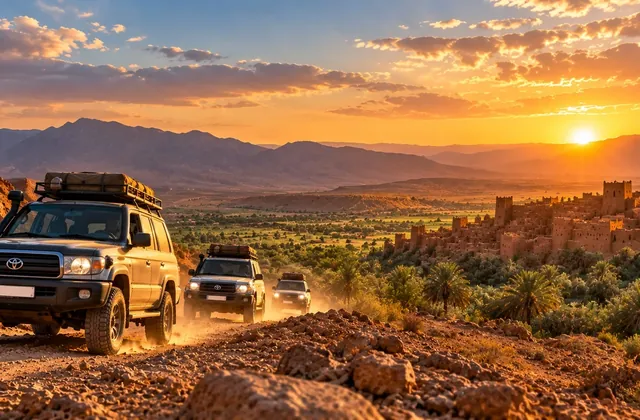
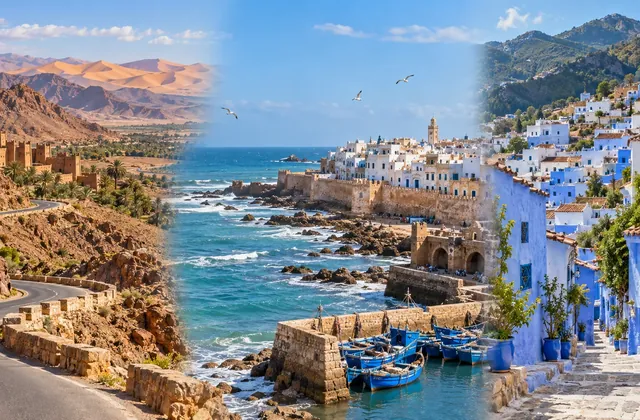
On the other hand, this solution becomes interesting for a longer trip including several regions: Tangier, Chefchaouen, Fez, Marrakech, the Atlas Mountains, Ouarzazate, the Dades Valley, Tinghir, Merzouga, Agadir or Essaouira .
You also avoid the constraints associated with renting: security deposit blocked on the bank card, deductible, inventory and possible restrictions concerning certain roads.
If you are still hesitating between the two options, our guide Renting a car in Morocco: everything you need to know before driving details the advantages and constraints of renting.
How to get to Morocco by car from Europe?
The most common solution is to travel to a European port and then take the car on a ferry.
From Spain, two crossings are particularly convenient:
- Algeciras – Tangier Med ;
- Tarifa – Tangier City .
Algeciras – Tangier Med is one of the main ferry routes between Europe and Morocco. The crossing takes approximately one and a half hours, and several companies offer daily departures.
Tarifa – Tanger Ville is even shorter, around an hour, and has the advantage of arriving directly in Tangier rather than at the Tanger Med port complex.
Tanger Med and Tanger Ville: they are not the same port
This is an important detail when you book the ferry.
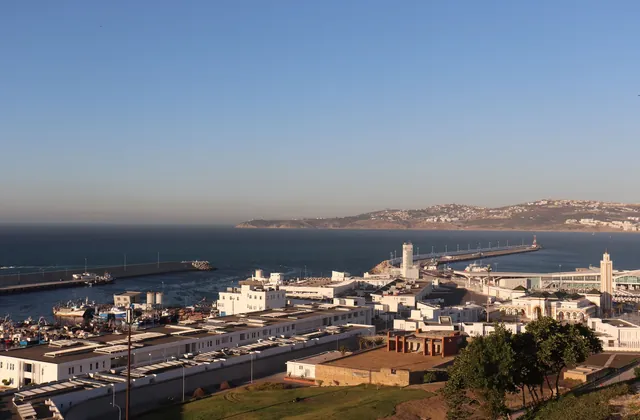
Tanger Ville is located directly in the city of Tangier, near the medina and the center.
Tanger Med is a large port complex located several dozen kilometers east of Tangier. However, it is directly connected to the road and motorway network, making it an excellent arrival point when you wish to immediately continue on to Tetouan, Chefchaouen, Rabat or the rest of Morocco.
If Tangier is your first tourist stop, arriving in Tangier City can be convenient. If your main goal is to start a road trip, Tangier Med is a great option.
Are there ferries from France?
Yes. There are also longer crossings that allow you to reach Tangier Med from Europe without going all the way down to the Strait of Gibraltar.
Tanger Med is notably connected to Sète and Marseille , as well as to Barcelona and Genoa.
These crossings are much longer than those from southern Spain, but they avoid several hundred or thousands of kilometers of road depending on your starting point.
The choice therefore depends on the cost of the ferry, fuel, European tolls and above all the time you have available.
And from Portugal?
For a traveler coming from Portugal, the most natural solution is usually to cross Spain and then reach Andalusia to embark at Algeciras or Tarifa.
The advantage is to benefit from short and frequent crossings to northern Morocco.
Depending on your starting point in Portugal and your Moroccan itinerary, however, compare the total cost of the journey, and not just the price of the ferry.
Do I need to book the ferry in advance?
This is highly recommended if you are travelling with a car.
The number of passengers can often be adjusted more easily than the number of vehicles on board. A car occupies a specific space in the ferry's garage, and availability can therefore decrease rapidly.
This is especially true during the summer, school holidays and periods of heavy traffic between Europe and Morocco.
When booking, correctly indicate the vehicle category and dimensions, especially if you are travelling with:
- a roof box;
- a bicycle rack;
- a trailer;
- a caravan;
- a motorhome or a converted van.
How long before the ferry should you arrive?
Don't think of it as if it were a simple inland boat trip.
With a vehicle, you generally have to register and then go through police and customs checks before boarding.
The required timeframes vary depending on the port, destination, and airline. During peak periods, allow ample time and check the check-in deadline indicated on your booking.
On the return from Tanger Med, vehicles follow a specific circuit including registration, document control, police, customs and then access to the dock.
Disable roaming before the crossing
If your European phone plan does not include Morocco, remember to disable data roaming before approaching the Moroccan coast .
Your phone can automatically connect to a Moroccan network as soon as one becomes available. Applications running in the background can then use data without your intervention.
You will be able to reactivate data if your plan covers Morocco or after installing a suitable SIM or eSIM.
To prepare for this aspect before departure, consult our guide Telephone and Internet in Morocco: European SIM, Moroccan card or eSIM?
What documents are needed to enter with your car?
Prepare the originals of the main documents before arriving at the port.
You will need, in particular:
- your valid passport;
- your valid driving licence;
- the original vehicle registration certificate;
- car insurance valid in Morocco;
- the necessary documents when the driver is not the owner of the vehicle.
It is also wise to keep digital copies of these documents on your phone or in a secure online space.
Is a European driving licence valid in Morocco?
For a tourist stay, a foreign driver can use their valid foreign driver's license in Morocco.
For foreign nationals, this possibility is limited to a maximum period of one year from the start of the stay.
An international driving permit can also facilitate certain procedures, particularly when a national permit is difficult to interpret, but it does not replace the original permit.
Does European insurance automatically cover Morocco?
Not necessarily.
Before departure, contact your insurer and explicitly verify that Morocco is included in the territorial coverage of your contract.
For certain European vehicles, the insurer issues an international motor insurance card or certificate, often still called a "green card". Morocco must be listed among the covered countries.
It is therefore not enough to assume that insurance valid in Spain, France or Portugal is automatically valid on the other side of the strait.
Important: the French green card has changed
Since 2024, the traditional green sticker is no longer used in France to prove insurance on French territory.
This does not mean that no documents are required to travel to Morocco.
For a vehicle registered in France, ask your insurer for the International Motor Insurance Card if you are travelling to Morocco and check that the territorial coverage corresponds to your stay.
For a vehicle registered in another European country, check with your own insurer about the international document to present.
What if my insurance doesn't cover Morocco?
Don't take to the road without insurance.
When foreign insurance does not cover Morocco, it is possible to purchase border insurance from an authorized organization at the point of entry.
This solution should be considered a last resort. It is generally simpler to check your coverage with your insurer before leaving Europe.
Take this opportunity to check not only mandatory civil liability insurance, but also assistance, towing, theft and vehicle damage.
Does roadside assistance work in Morocco?
This is a point that is often overlooked.
A contract may cover your civil liability in Morocco without offering exactly the same roadside assistance as in Europe.
Before setting off, ask what happens in case of a breakdown:
- Is towing covered?
- How far?
- Can the vehicle be repatriated to Europe?
- Are the passengers being taken care of?
- Is a replacement vehicle planned?
For a long road trip, these guarantees can be much more important than saving a few euros on the insurance premium.
What is temporary vehicle admission?
A vehicle registered abroad that enters Morocco for a tourist stay is placed under the temporary admission regime.
This scheme allows the vehicle to be used temporarily in Morocco without paying the duties and taxes that would apply to a permanent import.
The car therefore legally remains a foreign vehicle intended to leave Morocco at the end of the stay.
Do I need to fill out form D16ter before departure?
No. Many older articles available on the Internet still indicate that a D16ter declaration must be completed and printed before arriving in Morocco.
This paper-based procedure is outdated.
The handling of temporary admission is now carried out by customs officers in their computer system when crossing the border, on board certain ferries or at the entry point.
However, you must have the documents that allow you to identify the vehicle and its owner.
How long can you keep your car in Morocco?
For a passenger vehicle belonging to a visitor residing abroad, temporary admission normally allows the vehicle to be kept in Morocco for a maximum of six months during the calendar year , according to the applicable customs rules.
This duration refers to the vehicle and it should not be assumed that a simple quick round trip to the border automatically resets the counter to zero.
For a typical tourist stay of a few weeks, this limit obviously poses no problem.
Does the car have to leave Morocco?
Yes. That's a crucial point.
The vehicle, which is temporarily admitted, must normally leave Moroccan territory . Its entry is recorded by the authorities, and its departure must also be recorded.
So do not leave Morocco by plane simply leaving your car in a parking lot thinking you will come back to pick it up several months later without having checked the customs rules.
Upon leaving the country, ensure that the vehicle's exit has been properly recorded by customs.
What should I do if the car breaks down and I can no longer leave Morocco?
A major breakdown or accident does not eliminate the customs obligation related to the vehicle.
If your car can no longer leave the country normally, contact your insurer and customs services before leaving without it.
Depending on the situation, a specific procedure may be required to immobilize, repatriate or regularize the vehicle.
Do not simply leave the territory by abandoning a car placed under temporary admission.
What happens if the car is not registered in my name?
The situation must be prepared before departure.
If the vehicle belongs to a member of your family, a company, or another person, a power of attorney or authorization from the owner may be required.
For a vehicle under lease, long-term rental or financing with special restrictions, also contact the owning company or the organization concerned before the trip.
The authorization must clearly allow the driver to use the vehicle and, when necessary, to bring it into Morocco.
Can you come to Morocco with a European rental car?
Only if the contract explicitly allows it.
Never assume that a car rented in Spain, France or Portugal can automatically be shipped to Morocco.
The rental company must authorize the exit to Morocco and the contract must be compatible with customs and insurance formalities.
In many cases, renting a car directly in Morocco will be much simpler.
In this case, consult our guide Renting a car in Morocco .
What are the formalities like at Tanger Med?
Upon arrival at Tanger Med, travelers with vehicles follow the port's car circuit.
The formalities include passport control and customs control of the vehicle and luggage .
Police formalities can begin on board the ferry. Upon arrival, simply follow the vehicle signs to the checkpoints.
Once the formalities are completed, exiting Tanger Med provides direct access to the road network, including the RN16 and the routes leading to Tangier, Tetouan and the motorway network.
Preparing for your first hour in Morocco
Before leaving the port, check that you have everything you need for the rest of the journey:
- route loaded into the GPS;
- Internet connection or offline card;
- a few dirhams;
- Vehicle documents easily accessible;
- Your insurance company's assistance number.
To choose a SIM card or an eSIM, consult our guide Telephone and Internet in Morocco .
For withdrawals, currency exchange and payment methods, see also our guide Money in Morocco: cash, bank card, currency exchange and ATMs .
Moroccan highways
Morocco has a modern motorway network linking several major cities, including Tangier, Rabat, Casablanca, Marrakech, Fez and Agadir.
The highways are toll roads.
The tollbooths currently accept:
- the species;
- bank cards;
- the Jawaz electronic pass.
For a one-off tourist trip, it is not essential to buy a Jawaz pass. A bank card and a few dirhams are usually sufficient.
Do I need to buy a Jawaz pass?
Jawaz is the Moroccan equivalent of an electronic toll collection system. It allows the use of dedicated lanes and avoids manual payment at each barrier.
For a stay of a few days involving only two or three motorway journeys, its usefulness remains limited.
However, for a long road trip frequently using highways, it can provide a certain level of comfort.
Fuel and gas stations
Gas stations are numerous in cities, on major roads and on a large part of the road network.
Before heading to a more isolated region, particularly parts of the Atlas Mountains or southern Morocco, avoid waiting until the reserve tank is empty to fill up.
Also keep some dirhams available: even though card payment is common in major stations, it is always useful to have a backup plan.
Driving on Moroccan roads
We drive on the right, as in most continental European countries.
The main national roads are generally easy to travel and allow for a road trip with a conventional car.
However, one must remain attentive to the differences in traffic: scooters, bicycles, pedestrians, animals and slow vehicles may share the road, particularly at the entrance to towns and in rural areas.
Roadside checks and speed checks are also frequent.
Our guide to renting and driving in Morocco details roads, speed cameras, parking, city driving, and driving in the Atlas Mountains. This advice also applies to your own vehicle.
Avoid driving at night when it is not necessary
Major roads and highways can be travelled at night, but secondary roads require more vigilance.
Pedestrians, cyclists, animals or vehicles that are not easily visible may appear on the roadway and some rural sections are poorly lit.
For a road trip, it is best to plan realistic stages and arrive before nightfall when taking mountain roads or secondary routes.
Do you need a 4x4 to cross Morocco?
No. To travel on the country's main roads, a classic car in good condition is sufficient.
In particular, you can reach Marrakech, Ouarzazate, the Dadès Valley, Tinghir, Zagora or Merzouga by paved road without having a 4x4.
An all-terrain vehicle becomes interesting when the route includes real tracks, desert areas, or isolated sectors.
Before leaving a paved road, also check that your insurance and assistance cover the intended use.
Preparing the car before a long road trip
A pre-departure mechanical check is particularly recommended when the journey from Europe already represents several thousand kilometers round trip.
In particular, check:
- the condition and pressure of the tires;
- the spare wheel or the repair kit;
- oil and coolant levels;
- the brakes;
- the lighting;
- windshield wipers;
- the battery;
- Air conditioning if you are travelling during a hot period.
A minor breakdown in Europe or a major Moroccan city is relatively easy to manage. The same breakdown on a remote road in the Atlas Mountains or the south can halt travel for much longer.
Carry a spare tire
More and more recent cars are equipped with only a puncture repair kit.
For a route consisting exclusively of highways and main roads, this may suffice. For a trip including rural areas or roads far from cities, a proper spare tire can provide added security.
Also check that you have the jack and wrench needed to change the wheel.
Parking with a foreign car
A European registration does not require any special precautions, but apply the same rules as for a rental car.
In large cities, choose clearly marked car parks or those recommended by your accommodation.
If you are staying in a medina, check before arrival where you can leave your car. Many riads are obviously not directly accessible by car.
Do not leave passports, money, computers or luggage visible inside the vehicle when it is parked.
What to do in case of an accident?
Keep your insurer's contact details and those of their international assistance service in the vehicle.
In the event of a property damage accident involving another vehicle, an amicable settlement may be required.
In case of doubt or serious accident, contact your insurer before accepting an informal solution.
Also photograph the vehicles, damage, license plates and the general situation when it can be done safely.
Beware of packages entrusted to you by strangers.
When travelling by car between Europe and Morocco, it may happen that someone asks you to transport a package, a suitcase or an item for a relative.
Never agree to transport luggage or a package whose contents you do not know precisely.
Customs checks at ports and borders can be rigorous and the driver remains responsible for what is in their vehicle.
Other useful situations to know before the trip are presented in our guide The pitfalls to avoid in Morocco: tips for traveling with peace of mind .
Preparing for the return to Europe
Don't consider the return ferry as a mere formality.
Allow sufficient time for:
- to reach the port;
- perform the registration;
- pass through police checks;
- have the vehicle and luggage checked by customs;
- register the vehicle's exit from Morocco;
- proceed to the boarding area.
At Tanger Med, passengers with vehicles use a specific route and complete part of the formalities directly from their car.
During peak season, do not plan a last-minute arrival at the port.
Verify that the temporary admission is properly closed.
When you permanently leave Morocco with the vehicle, its departure must be registered with customs.
This is particularly important to prevent a vehicle from later appearing to still be present on Moroccan territory.
Keep the documents given to you when going through customs and, if there is an anomaly, have it corrected before leaving the port area.
Should I bring my own car or rent one in Morocco?
Bringing your own vehicle is particularly advantageous for a long stay or a major road trip . You know your car, you can carry more luggage, and you don't have to pay a deposit or rental excess.
On the other hand, for a one or two week trip requiring travel across France or Spain before even reaching the ferry, flying followed by renting a car may be simpler.
Therefore, we need to compare:
- the price of the ferry with vehicle;
- fuel in Europe;
- tolls;
- any overnight stays;
- travel time;
- the cost of an equivalent rental in Morocco.
For travellers who prefer not to drive at all, our guide Travelling in Morocco without a car: how to get around? also presents alternatives by train, coach, taxi and transfer.
The checklist before hitting the road to Morocco
- Valid passport.
- Valid driver's license.
- Original registration certificate.
- Insurance explicitly covering Morocco.
- International insurance card or certificate if required.
- Verified roadside assistance for Morocco.
- Owner's authorization if the vehicle is not registered in your name.
- Confirmed ferry ticket for the vehicle.
- Correct vehicle dimensions indicated at the time of booking.
- Data roaming is disabled if your plan does not cover Morocco.
- Offline maps downloaded.
- Vehicle serviced and tires checked.
- A few dirhams available for initial expenses.
With these checks completed before departure, traveling to Morocco with your own car is relatively straightforward. The ferry crossing and customs formalities add a few steps to the journey, but then offer considerable freedom to explore the country at your own pace.